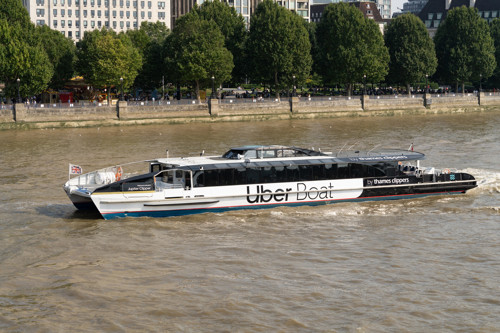
RB6 River Bus service background

  • Thames Clippers (TC) have been operating a River Bus from Putney Pier since April 2013. This is known as the RB6 service shown in yellow in Figure 1 (Putney to Canary Wharf).
  • This service was tendered by Transport for London (TfL), which TC won and was then operated under a contract between TfL and TC.
  • As part of the contract TfL paid each pier on the RB6 route a pier fee for the piers on the route (i.e., Putney, Wandsworth Riverside, Plantation Wharf, Cadogan Pier, Chelsea Harbour and St George Wharf). Battersea Power Station was added in November 2017 with access being agreed separately by TC and the developer.
  • The TfL contract ended in 2019 and since then TC have been operating under a long-term Licence from TfL, but operating solely at commercial risk. The negotiated pier fees were also inherited from TfL.
  • Licences to use the piers were assigned over to TC at the end of the TfL Contract except for Putney Pier, where terms were never formally agreed legally between TfL and the pier owner, but fees were paid and access was granted for the River Bus. This position remains today with the operation using the pier, under the same terms agreed with TfL, with no signed agreement.
  • Since 2013, TC has built 5 new catamarans and invested over £20m in its fleet to deliver a weekday peak service broadly between 06:00 – 11:00 and 16:00 – 22:30 Monday to Friday.
  • TC currently has three new hybrid electric clippers under build which will permit zero emission operations within the central London zone. This will enable the replacement of older vessels and the introduction of a partial off peak and weekend service for the RB6 route, something that customers and MPs have requested and lobbied for some time. Please see live petition notice here.
  • Such investments have a design life of at least 20 years and a long return on investment so it is critical for the future of the River Bus service in west London that long term pier access is secured and maintained.

Figure 1: River Bus services 2022
(Click here for full screen view)


The existing Putney Pier (current access)

Technical Constraints and Limitations

  • The current pier does not allow access on certain high-tides for passengers as the entrance floods, as noted in the planning documents.
  • The pier is over 130 years old and much of its infrastructure is original. It does not meet today’s accessibility standards for a public transport facility; indeed, it is not DDA compliant at any tide below mean-water, and would require substantial investment in order to do so. This work would include a new brow and bankseat, a new larger pontoon that would need to extend further out into the river with new mooring piles.
  • Even with this work the flooding land access would remain a constraint, with flooding expected to become a more significant issue in the future due to climate change.
  • The owner’s proposed scheme (planning case ref. 2022/1280) for expansion of the current pier does not resolve the flooding, steep brow or pontoon investment needs
  • The current pier is positioned adjacent to the position that rowers both cross and turn, meaning any further development could lead to more complex navigational manoeuvres required to ensure safety of all river users in the region (refer to the Navigational Risk Assessment for further details, ref. 2038-BRL-02-XX-TN-C-0005).
  • The current pier does not allow for double gate boarding or disembarkation which slows the River Bus service, limits capacity and restricts the ability for future expansion.
  • It is believed that building an access brow from the Tideway site onto the current pier is not possible due to Thames Water’s servicing needs which requires the upstream end of the build-out to be free of obstructions as that is where their access covers for the tunnel drop shaft are located.

Commercial Constraints and Limitations

  • The pier fees inherited from TfL to access Putney pier represent an annual charge which is greater than all of the other RB6 piers combined. The fee mechanism for Putney is based on the number of vessel calls rather than a fixed annual fee, making any growth in service challenging when passenger demand varies significantly through the day.  The pier fee mechanism is therefore unsustainable for TC to grow its route and fleet.
  • TC have written consent to use the pier but have no formal legal agreement to use the pier and scheduled RB6 services have to give way to charter vessels if they are booked at the pier. This causes delays to the RB6 service.
  • Over the last 3 years TC have met with the owner of the pier, Livett’s Launches (LL), to seek to agree a long-term access agreement. Despite these efforts the access remains on a short-term basis with no formal agreement for access.  This compares with 10–15 year access agreements at the other RB6 piers. 
  • TC and others interested parties have held discussions with LL to consider buying the current Putney Pier.  Both did not materialise as the asking price made it unviable alongside the investment that is needed to upgrade the pier for the long term (noting the constraints noted above).   For context, a new pier to safeguard the future of the River Bus service could be delivered for less.

A new pier at Putney Bridge (proposed access)

Putney Bridge Pier CGI